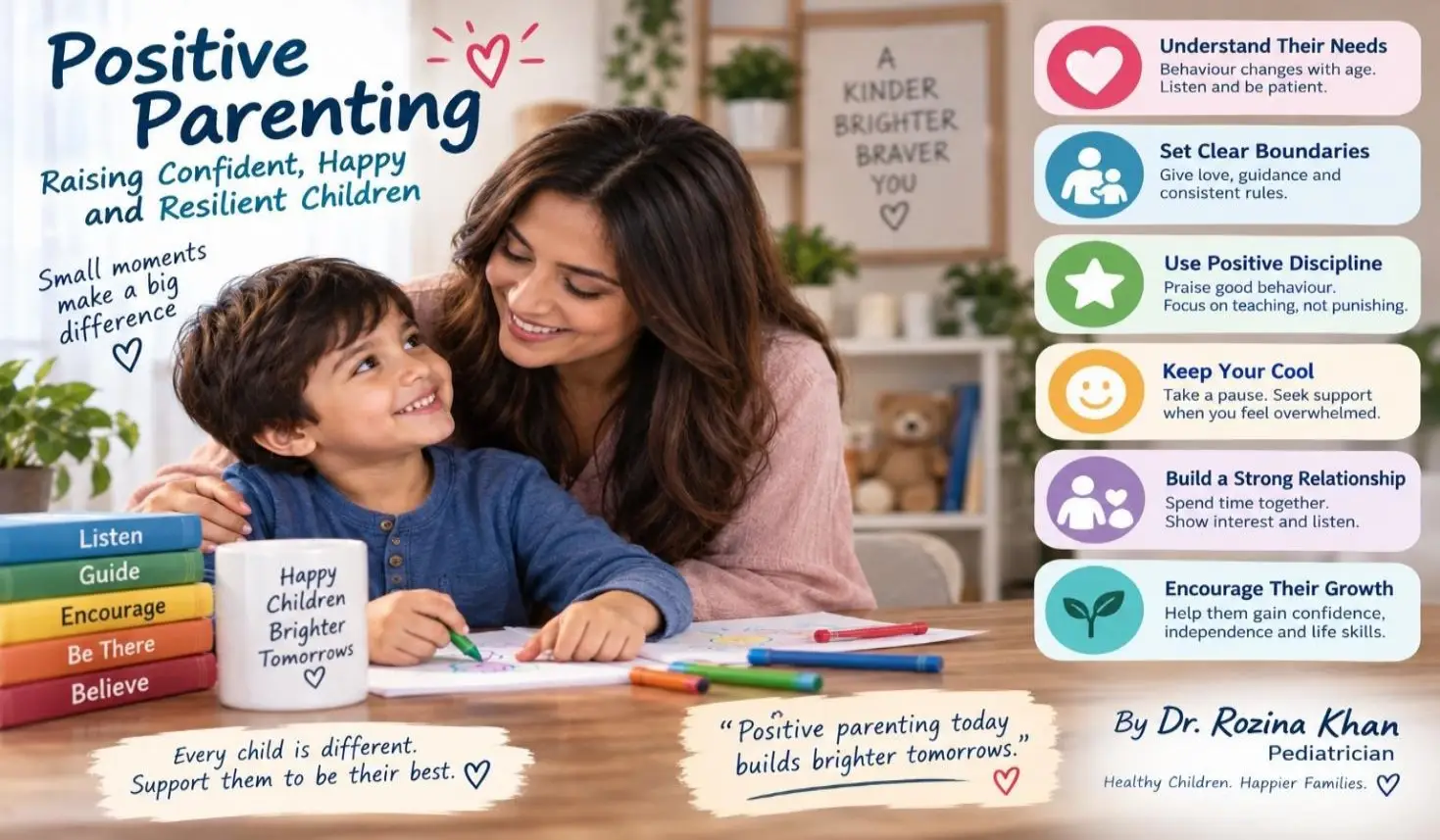
By Dr. Rozina Khan, Pediatrician
Parenting is one of the most rewarding—and sometimes one of the most challenging—responsibilities in life. Every child is different, and there is no single parenting approach that works perfectly for every family.
Positive parenting is about guiding children with love, consistency, understanding and appropriate boundaries rather than fear or punishment. It helps strengthen the parent-child relationship while reducing stress for both parents and children.
Understanding Your Child’s Behaviour
One of the most important steps in positive parenting is understanding that children’s needs and behaviour change as they grow. What may seem like difficult behaviour can often be a normal part of development.
👶 Babies
Babies communicate their needs through behaviour. When a baby cries, they may be hungry, tired, uncomfortable or need a diaper change.
Even when an older baby pushes food away or resists a diaper change, they may simply be expressing their likes and dislikes in the only way they know.
A baby is not deliberately trying to misbehave or provoke a parent. Never shout at, shake, hit or smack a baby.
🧒 Toddlers
Tantrums and testing boundaries are common during the toddler years.
A toddler’s brain is still developing, including the ability to control emotions. What parents may interpret as “naughty behaviour” can therefore be a normal part of growing and learning.
Instead of asking, “Why is my child behaving like this?”, try asking:
“What is my child trying to communicate?”
📚 School-Age Children
School-age children are constantly learning and exploring. They ask questions, develop their own opinions and gradually seek greater independence.
As they become more independent, they may challenge rules or test boundaries. This can be a normal part of growing up.
🧑🎓 Teenagers
Teenagers are developing their own identity. They may become quieter, more private or more willing to disagree with their parents.
Friends and other influences may become increasingly important, and teenagers may not always make the choices their parents would prefer.
This is a time when communication becomes more important—not less.
Setting Healthy Boundaries
Children need love, guidance, rules and boundaries.
Clear boundaries help children understand what behaviour is acceptable and what is not. However, expectations should be appropriate for the child’s age and stage of development.
Practical tips for parents
✔️ Keep rules simple and consistent.
✔️ Explain what you want your child to do instead of focusing only on what they did wrong.
✔️ Make time for your child so they feel comfortable coming to you when something is wrong.
✔️ Listen—even when the conversation is difficult.
✔️ Review family rules as your child grows.
✔️ Remember that a four-year-old and a twelve-year-old cannot be expected to behave in the same way.
For younger children
Introduce boundaries early. Try to recognize and name their emotions—for example:
“I know you’re frustrated.”
Sharing your own feelings appropriately can also help children understand emotions. Try to avoid relying on constant orders and ultimatums.
For older children and teenagers
Give children opportunities to demonstrate that they can be trusted.
When they make a mistake, focus on the behaviour or action rather than attacking the child’s character. Avoid unnecessary arguments and, as children become older, consider negotiation and offering reasonable choices.
Discipline: Teach, Don’t Frighten
Discipline should help children learn appropriate behaviour—not make them afraid of their parents.
Some children respond well to reward charts or other incentives, while others may respond differently. Parents need to understand what motivates their individual child.
Try these positive discipline strategies:
🌟 Praise good behaviour whenever possible.
🎁 Reward positive behaviour and, when appropriate, involve your child in deciding what would be a meaningful reward.
🧘 Avoid making decisions while angry.
💬 Explain rewards and consequences before they happen, rather than only after a problem occurs.
👂 Listen carefully to what your child is saying and explain your own feelings.
👨👩👧 Be a role model. Children learn from what they see adults doing.
Why Physical Punishment Should Be Avoided
The source emphasizes that smacking is not an effective form of discipline and may negatively affect the parent-child relationship.
Physical punishment can make children feel resentful or angry and may teach them that hitting is an acceptable way to deal with problems. Some children may also respond by lying, hiding their feelings or becoming withdrawn.
Discipline should teach a child what to do differently—not simply punish them for what they have done.
Parents, Take Care of Your Own Emotions Too
Parenting becomes much harder when a parent is exhausted, overwhelmed, anxious or angry.
Stress can come from many sources—including family relationships, work-life pressures, financial difficulties, health concerns and other responsibilities. When stress becomes overwhelming, parents may lose their temper and say or do things they later regret.
Taking care of yourself is therefore part of taking care of your child.
When you feel overwhelmed:
Take a pause.
Step away if it is safe to do so.
Take a few deep breaths.
Ask someone you trust for support.
Return to the situation when you feel calmer.
And remember: asking for help is not a sign of weakness.
Parents should also make time for themselves—through exercise, music, walking, relaxation or other activities they enjoy.
Build a Positive Relationship With Your Child
A strong parent-child relationship provides a foundation for healthy emotional development.
Showing unconditional love and affection is important, even when children are challenging. Spending time together and learning together can strengthen your bond, increase your child’s confidence and help you understand their needs better.
Five simple ways to strengthen your relationship
❤️ Show interest in what your child likes.
🎲 Find enjoyable activities to do together.
👂 Ask your child’s opinion and genuinely listen.
🌱 Focus on small improvements rather than expecting immediate change.
🤝 Be willing to compromise and acknowledge when you have made a mistake.
Sometimes a simple 10–15 minutes of undistracted time together can mean more to a child than an expensive gift.
Every Child Is Different
There is no perfect parent, and there is no perfect child.
Your child may have a completely different temperament, personality and set of needs from their siblings. Parenting strategies may therefore need to change as children grow.
The goal is not to control every behaviour.
The goal is to guide, teach, listen, connect and gradually help children become independent and responsible individuals.
A Message From Dr. Rozina
Positive parenting does not mean saying “yes” to everything.
It means being loving without being permissive, firm without being harsh, and consistent without being frightening.
Your child needs boundaries—but they also need to know:
“I am loved.”
“I am heard.”
“I can make mistakes and learn.”
“My parents are there for me.”
When we replace fear with understanding and punishment with teaching, we create an environment where children can learn, develop confidence and build healthy relationships.
**Parenting is not about raising a perfect child.
It is about building a strong enough relationship that your child feels safe growing into who they are.**
Dr. Rozina Khan
Pediatrician | General Pediatrics | Child Development | Autism & ADHD Assessments